Why Organizational Problems Are Like Migraines

The symptoms are obvious. The causes aren’t.
Imagine waking up with a severe migraine.
The pain is real. The symptoms are obvious. The discomfort is impossible to ignore.
But a good doctor doesn't simply treat the headache.
A migraine can have dozens of different causes: stress, dehydration, lack of sleep, hormonal changes, medication reactions, vision problems, or underlying health conditions. Two patients may have the exact same symptom but require completely different treatments.
The doctor's first responsibility is diagnosis. Only after identifying the root cause can the right treatment be prescribed.
Many organizational challenges work the same way. Leadership teams often experience symptoms such as:
The Strategy Execution Gap: A growing gap between strategy and execution (the “Shelf Problem”)
Change Resistance: Stalled progress, slow decision-making, or unexplained resistance to change
The Tactical Ceiling: High-performing middle managers who can execute well, but struggle think organizationally as the company scales.
Executive Team Friction and Silos: Territorial behavior across departments and polite compliance that hides underlying frictions.
Reactive Leadership: Executive teams constantly putting out tactical fires instead of casting vision and driving strategy
Inconsistent Performance: Difficulty sustaining momentum despite strong growth
These symptoms are real. They create frustration, lost opportunities, and performance challenges. But they are rarely the actual problem.
Is it a Strategy, Execution, or People Problem?
Just as a migraine can stem from different underlying conditions, organizational symptoms often emerge from multiple, interconnected causes. What's visible on the surface may be rooted in strategic confusion, execution breakdowns, leadership capacity issues, or some combination of all three.
Unfortunately, many leaders and consultants approach every problem through a single lens.
Operations consultants assume every challenge is an execution problem.
Visionaries and Strategy Forms assume challenges are strategy problems.
Still others assume challenges can be solved through training people.
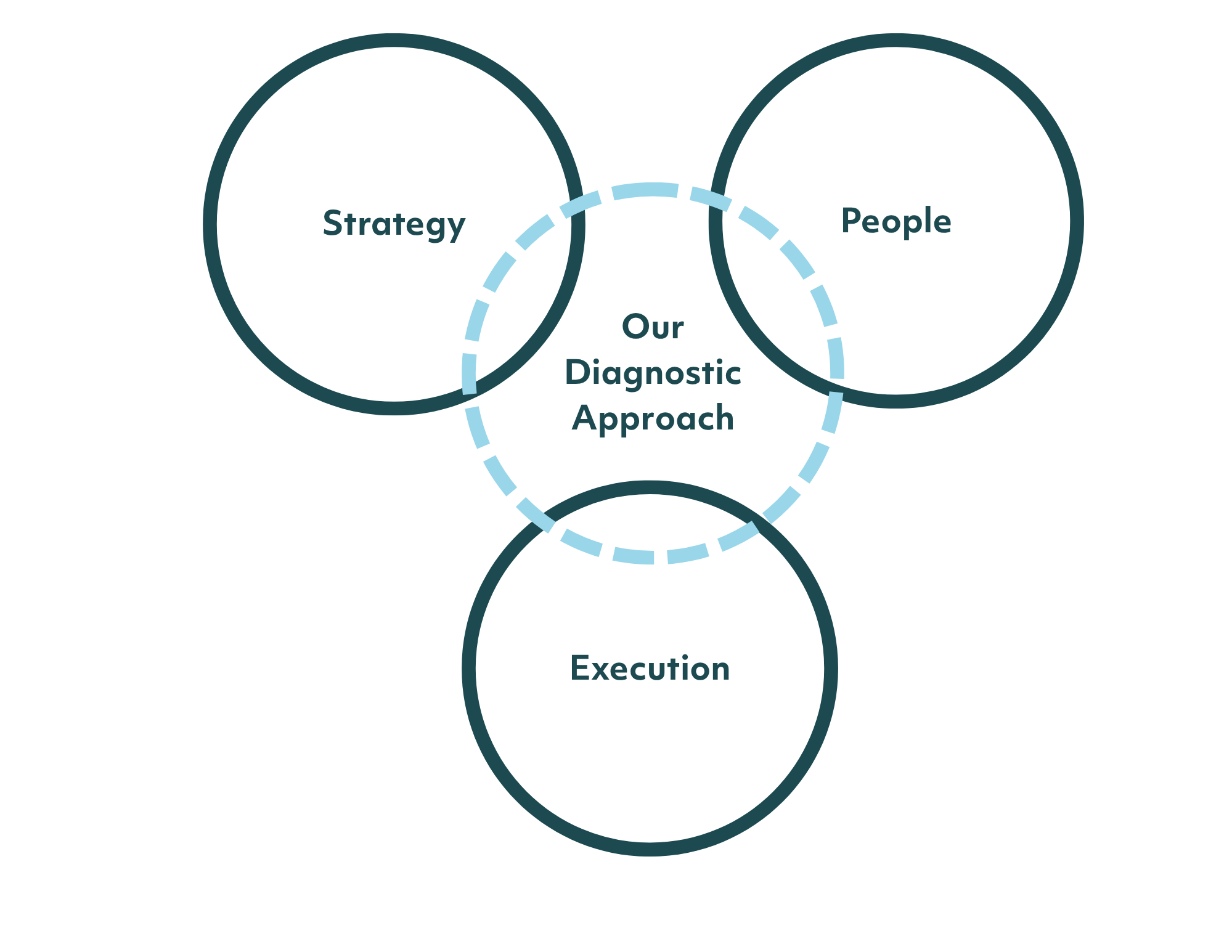
The reality is that organizational performance exists at the intersection of strategy, execution, and people. When one area is misaligned, the symptoms often appear somewhere else entirely.
That's why objective diagnosis matters. Before prescribing solutions, leaders need a clear understanding of what's actually driving the challenges they are experiencing.
At Awaken Leadership Solutions, we help executive teams identify the root causes behind organizational performance issues through a structured diagnostic process using multiple lenses. We examine the organization's strategic clarity, operational systems, leadership capacity, and overall organizational health to understand how these elements interact.
Only then do we design interventions tailored to the organization's specific needs. Because treating symptoms without understanding causes rarely produces lasting results.
In our work, we've found that healthy organizations are built by forming leaders and creating systems that reinforce strategic clarity, consistent accountability, and aligned execution. That's why our philosophy is simple: Form the Leader. Build the Organization.
Diagnosis helps us understand where alignment is breaking down. Leadership development, strategic clarity, and execution systems help us restore it.
The Three Diagnostic Lenses for Organizational Health
The Strategy Lens: Moving from Goals to Strategic Clarity
Many leaders confuse strategy with goals. A goal is an outcome, while a strategy is the approach that enables you to achieve that outcome.
"Increase revenue by 20%." "Open three new locations." "Improve profitability." These are goals. They are important, but they are not strategies.
A true strategy answers a much deeper question: Why do customers choose you instead of your competition?
That question forces executive teams to move beyond discussing products, services, and internal priorities. Instead, it places the customer at the center of the conversation.
The most successful organizations understand that customers don't purchase products or services. They purchase solutions to problems, progress toward goals, or outcomes they care about.
When leadership teams lose sight of this reality, strategic clarity begins to erode.
Often, I see organizations where executives genuinely believe they agree on the company's direction. But when decisions need to be made, budgets are allocated, or priorities are established, very different assumptions emerge.
That's when strategy becomes vulnerable to what I call the "shelf problem."
An organization invests significant time and resources creating a strategic plan. The plan is celebrated, documented, distributed, and then quietly placed on a shelf while day-to-day operations take over.
Six months later, leaders are pursuing competing agendas. Departments are operating from different priorities. Resources are being allocated inconsistently. The strategy exists on paper …but not in practice.
The cost of unclear strategy extends far beyond the executive team. It creates friction throughout the organization, slowing decision-making and generating unnecessary operational drag.
This is why much of Awaken’s work begins by helping owners, boards, and executive teams establish genuine strategic clarity. Through facilitated strategic conversations and executive team off-sites, we help leaders align around a shared understanding of where the organization is going, why it matters, and how success will be achieved.
The Execution Lens: Building Processes and Systems that Reinforce Strategy
Even the best strategy is meaningless if it cannot be executed. Execution is where strategy becomes tangible.
It's where vision turns into behaviors, systems, processes, and decisions that shape everyday work across the organization.
The question every leadership team should ask is: Do our systems reinforce our strategy?
To answer, consider a few angles:
Are we measuring the right things?
Do our key performance indicators reflect our strategic priorities?
Are employees focused on the work that creates the greatest value?
Do our processes support the customer outcomes we promise?
Are resources being allocated according to strategic priorities?
If the answer to these questions is unclear, there is likely a disconnect between strategy and execution.
Too many organizations leave employees guessing.
Employees shouldn't have to wonder what matters most. They shouldn't have to interpret competing priorities from different leaders. They shouldn't have to decide whether the strategic plan or the crisis of the week deserves their attention.
When execution systems are aligned, people understand how their daily work contributes to organizational success. Performance metrics reinforce priorities. Processes support value creation. Accountability becomes clearer.
In healthy organizations, strategy is not something discussed once a year during planning season. It is embedded into how the organization operates every day.
The People Lens: Developing Leadership Capacity at Scale
Even organizations with a compelling strategy and well-designed systems can still struggle.
Why? Because organizations execute through people. Leadership capacity ultimately determines organizational capacity. As companies grow, leaders must grow with them.
The skills required to manage a team of ten people differ significantly from the skills required to lead a department, oversee a business unit, or guide an entire enterprise through complexity and change.
This is why leadership development cannot be treated as an isolated training event.
Organizations need intentional talent systems that continuously develop leaders while supporting strategic objectives.
That includes:
Leadership competency frameworks
Performance management systems
Succession planning
Professional development pathways
Research-Based Executive Coaching and Formation
The goal is not simply to teach leaders new skills.
The goal is to build leaders who can navigate ambiguity, make sound decisions, align teams, and drive strategic outcomes.
When leadership development, business systems, and strategy operate independently, organizations create unnecessary friction. When they work together, they create momentum.
This is where we help organizations build leadership and talent systems that strengthen execution, increase leadership capacity, and support long-term growth.
Bringing It All Together
Most executive teams don't need another generic keynote or off-the-shelf solution. They need an accurate diagnosis.
The challenges you're experiencing may look like a strategy problem. Or an execution problem. Or a people problem.
In reality, the root causes are often interconnected.
A lack of strategic clarity can create execution failures. Weak execution systems can frustrate talented leaders. Leadership gaps can undermine even the strongest strategic plans.
That's why our work begins with helping leaders gain visibility into what's really happening beneath the surface. Through a structured assessment process, we identify where strategy, execution, and leadership systems are reinforcing one another and where they are creating friction.
Once the root causes are clear, organizations can stop treating symptoms and start building sustainable solutions.
Start With a Diagnostic: Not a Prescription
Before prescribing solutions, it's important to understand the true causes behind organizational challenges.
Our Organizational Health Scan provides CEOs and executive teams with an objective view of organizational performance across three critical dimensions:
Strategic clarity
Execution effectiveness
Leadership and talent capacity
The assessment helps uncover:
Strategic alignment gaps
Breakdowns between strategy and execution
Organizational barriers that slow growth
Leadership pipeline vulnerabilities
Executive team alignment challenges
Hidden risks impacting performance
The scan frequently serves as the foundation for a facilitated executive off-site where leadership teams review findings, align around priorities, and develop a clear path forward.
Because the first step toward solving any problem is understanding what's causing it.
For CEOs and Founders: Take our complimentary Organizational Health Scan
For Executive Teams: Schedule a Diagnostic Consultation with Dr. Aaron Einfeld to evaluate your team’s alignment and operational health.
Read More